
The Marais reads, on paper, like an adults' neighbourhood — boutiques, galleries, café terraces. So most parents either skip it with children or spend the afternoon steering them past shops nobody wanted to see. Neither is necessary. Done right, the Marais is one of the best days in Paris for a whole family — there's wonder for the kids and a real Paris for you, in the same few streets.
Here's the whole day, laid out roughly south to north so it walks in one easy direction — from the river up to the market. The secret is how tightly it packs together: every stop is just a few minutes' walk from the next, with no metro in between, and there's a café, a bench, a garden or a playground built in whenever you need to pause. A full day, but a gentle one. Start near métro Saint-Paul (M1).
Why the Marais works for the whole family
The Marais is old, dense, and full of texture — carved stone faces above doorways, enormous wooden doors, archways into hidden courtyards, shapes that repeat if you watch. None of it needs explaining to be interesting to a child; it just needs pointing at. And it's walkable for small legs: a short loop with natural places to stop, not a march between big sights. You walk one good chapter and leave while it still feels light.
The day has an easy rhythm to it: something to discover, room to run, then a calm stop to reset — over and over, all day. Keep that going and a long day in the Marais stays light instead of tipping over.
The day, scene by scene
Nine stops, all within a few minutes of each other, south to north — with a rest built into nearly every one, so a full day still feels easy. Here's the whole route on a map; the numbers match the stops below.
- Breakfast by the river — Chez Julien. Begin gently at Chez Julien (1 rue du Pont Louis-Philippe), a storybook-pretty corner near the Seine and the Île Saint-Louis. A calm, beautiful start before the streets fill. Small and popular — book or arrive early.
- Hunt the giant doors, around rue des Francs-Bourgeois. Let your child find the biggest, oldest porte — the one that "belongs to a giant." It never wears out.
- Find the faces. The Marais is carved with stone heads and creatures above its windows and gates. Challenge them to spot three.
- Slip through the Hôtel de Sully passage. From rue Saint-Antoine, the hidden passage through the courtyards opens straight onto Place des Vosges — a real "secret door" moment.
- Place des Vosges — run, then Victor Hugo's house. The oldest planned square in Paris: arcades to tear under, a garden to reset in. Then duck into the Maison de Victor Hugo on the square — the writer's actual apartment, free to visit, easily done in 15–20 minutes. Permanent home free; closed Mondays.
- Lunch at the Marché des Enfants Rouges. The oldest covered market in Paris (39 rue de Bretagne) — Japanese roast-chicken plates, Italian, French, something for every appetite under one roof. It gets busy: aim for just before noon or after 2, and it's closed Mondays.
- Dessert along rue de Bretagne. The street is lined with pâtisseries and treat shops — pick one for a goûter to eat on the move.
- Run it off in the botanic garden at Square du Temple. A leafy little garden with a proper playground — the spot to burn off the last of the energy after lunch.
- A bit of shopping for mum and dad — Merci. An easy, lovely browse at the concept store on boulevard Beaumarchais (111), with a café for a coffee and a slice of something while the kids decompress. The one stop that's genuinely for you.
Where to eat & treat tap to open
- Lunch — Marché des Enfants Rouges (39 rue de Bretagne). Covered, lively, and something for everyone — Japanese roast-chicken plates, Italian, French. Busy at peak; go just before noon or after 2. Closed Mondays.
- Dessert — rue de Bretagne. A run of pâtisseries and treat shops right there; pick one for a goûter on the move.
- Hot chocolate at Place des Vosges — Carette, under the arcades, for a sit-down chocolat chaud if you'd rather a calm stop than the market.
- Coffee for the grown-ups — the Merci café. The concept store's café is a genuinely nice place to pause with a coffee and a slice while the kids decompress.
A day for the grown-ups, too
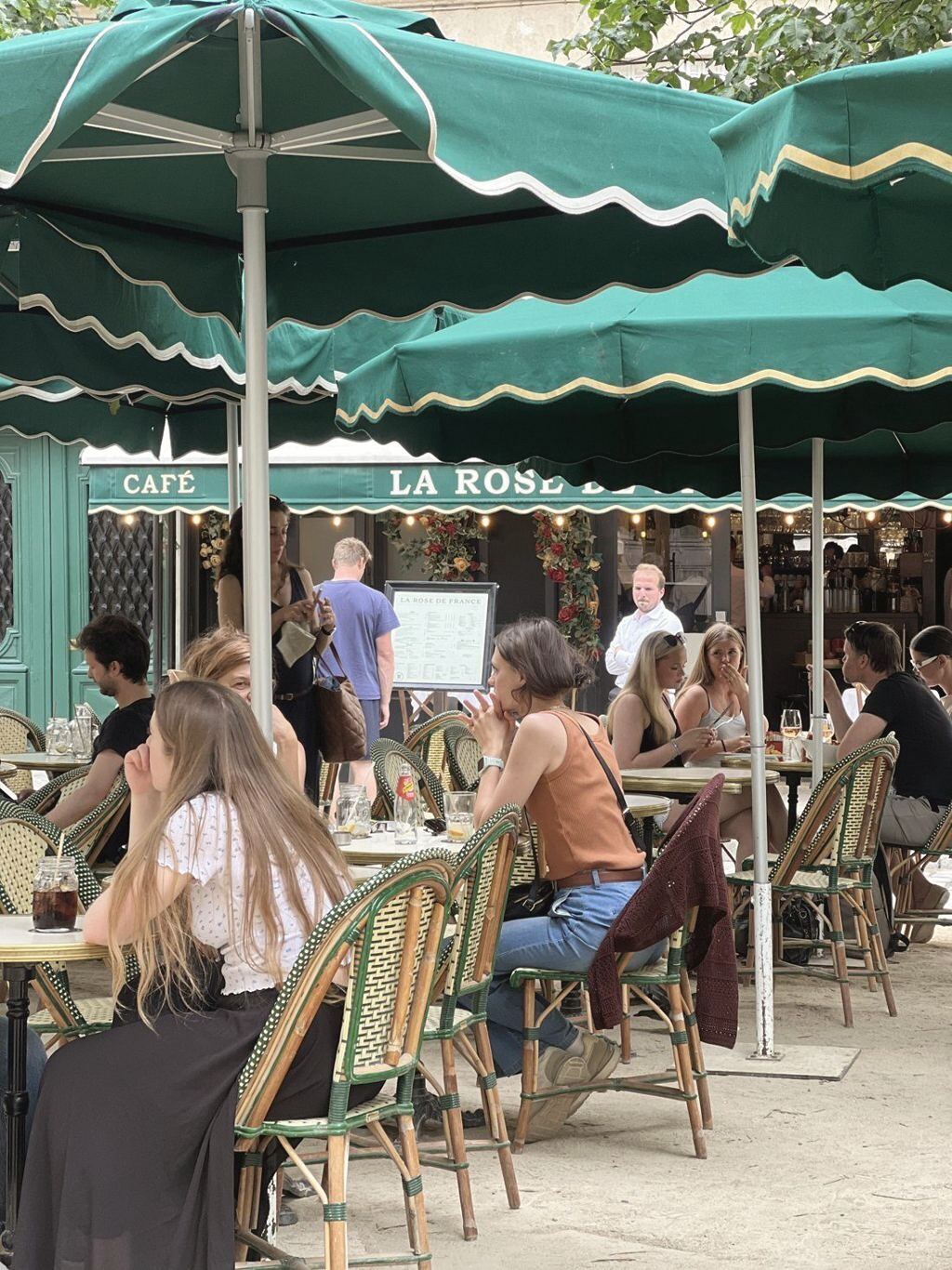
This is the rare family walk that hands the adults a real Paris of their own — a slow, beautiful breakfast by the river, an easy browse for yourselves at Merci, a proper coffee, and streets that are a pleasure to wander whether or not anyone is four. You're not just running the day; you get to be in it.
If it rains tap to open
Much of this day is already under cover — the market, Merci and Victor Hugo's house all keep you dry. If you want a proper indoor anchor, two small museums here are easy on a child:
- Musée Carnavalet (rue de Sévigné) — the museum of the history of Paris, told with shop signs and everyday objects at child height. Permanent collection free, so 30 minutes costs nothing if you leave early. Tuesday to Sunday, roughly 10am–6pm, closed Mondays; book a free timed slot.
- Musée de la Chasse et de la Nature (62 rue des Archives) — small, strange, animals at child height; like a curious mansion. Under-18s free. Tuesday to Sunday, roughly 11am–6pm, closed Mondays, with a late opening on Wednesday.
Prefer to be guided? Family detective-style tours use the Marais — Place des Vosges, Carnavalet, rue des Rosiers — as clue locations in a story; check current operators, ages, and prices before you book.
The reset games (and the memory)
This walk is mostly release, so the moves you'll actually use are the ones that carry a child from one scene to the next without a battle. Three from our little reset kit fit the Marais especially well:
- Silly shakes. When a queue or a crowd starts to fray things, shake it out — hands, arms, the whole wiggly lot — then carry on. Thirty seconds resets a stalling child.
- The walk-like game. Creep like a fox down a narrow passage, tiptoe like a fairy through a courtyard, take giant slow steps past the biggest doors. It moves a tired child along on a walk, which is exactly where the mood usually slips.
- The five-senses pause. When you stop, or when a tired stretch threatens, drop into I Spy with ears, nose, and fingertips: "What can you hear in this courtyard that you couldn't on the big street? What does this old door feel like?" It settles a fraying child and deepens the noticing at the same time.
The neighbourhood is built for noticing — a few openers:
- "Which door looks like it hides a secret garden?"
- "What shape keeps repeating — in windows, gates, or paving?"
- "What tiny surprise did you find above eye level?"
A mission to carry home: photograph three doors, or draw a door your child thinks belongs to a giant, a poet, or a queen.
Practical tips
- Not on a Monday. This is the big one: the Marché des Enfants Rouges, the Maison de Victor Hugo, Carnavalet and the Chasse all close Mondays. Pick another day or you lose half the plan.
- Lean on the breaks. It's a full day, but everything's only a few minutes apart and there's a bench, café, garden or playground at almost every stop — use them and it stays gentle.
- The market gets busy. Marché des Enfants Rouges is busiest roughly 12:30–2; arrive just before noon or after 2 for space and shorter queues.
- Book breakfast. Chez Julien is small and popular — reserve, or arrive early.
- Confirm before you go. Paris is alive: check the carousel is running and the current hours for Merci, the market and the museums close to your dates.
- Walking & strollers. South-to-north so you walk in one direction; old streets, narrow pavements, some cobbles. Manageable with a stroller, with a few tight stretches.
- Bathrooms. Public toilets are limited — but most cafés and restaurants will let you use theirs if you ask politely, especially with children. The market and museums are reliable too.
- Rain. Much of the day is already covered — market, Merci, Victor Hugo's house — and the two museums above are full indoor swaps.
The Marais is a small neighbourhood, but the difference between a lovely two-hour loop and a tired, aimless wander is entirely in the sequencing: which door first, where the rest stop falls, when to leave. That's the part worth getting right before you go.
Keep exploring
A Marais walk is one chapter of a bigger, easier Paris. Find the rest in our guides — the playful approach to Paris with a five-year-old, a short museum visit, and the introduction to easy days in the city with children.
Want this done for you?
And if you'd love a walk like this mapped around your own family — your hotel, your pace, your child's energy — that's what we design. Start with our free sample, The Sailboat & Left Bank Day, to see how it comes together.
See the free Sample Edit