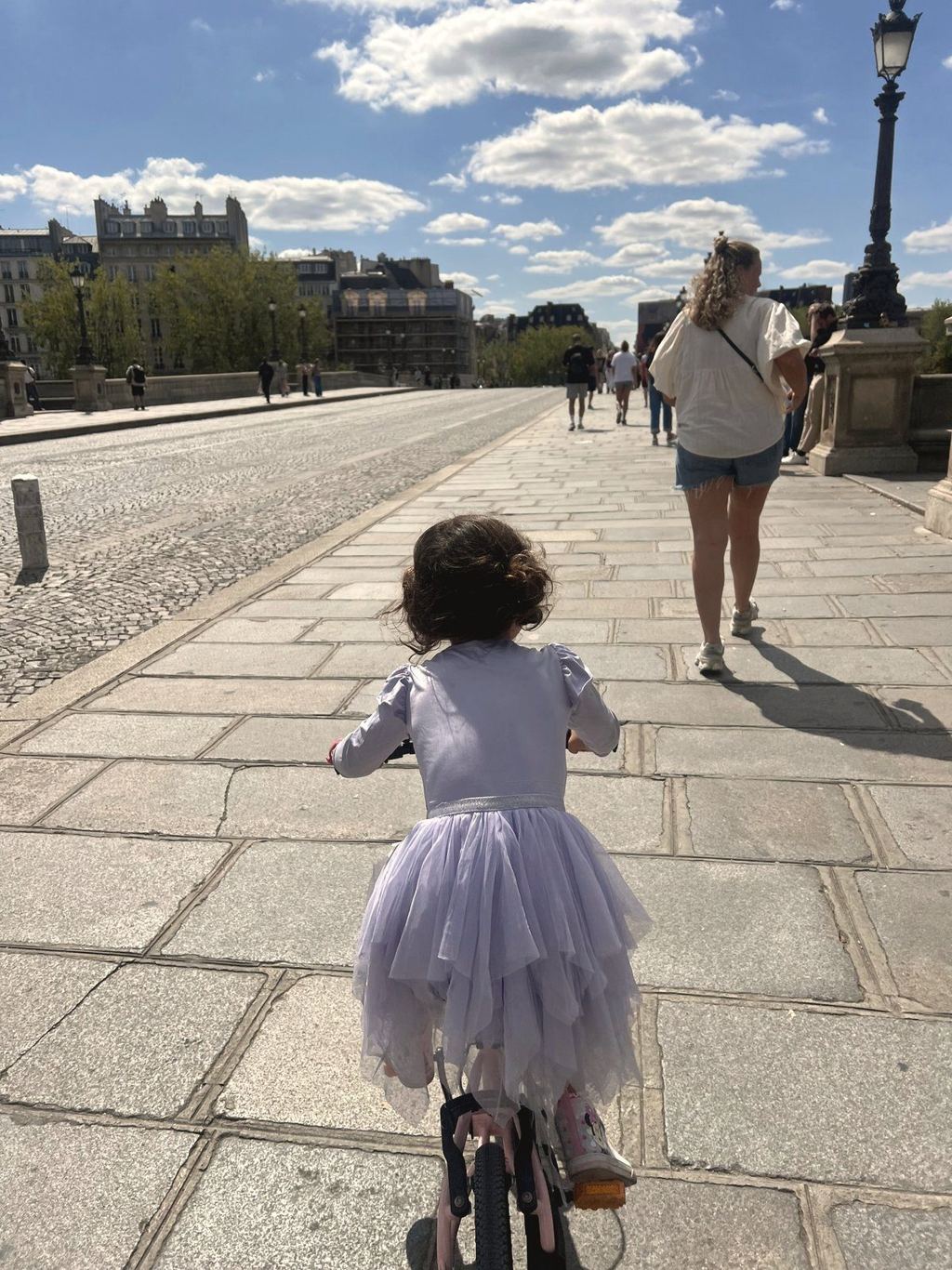
You've probably already got fourteen tabs open. One blog says do the Eiffel Tower at sunset; a video says skip it; a guidebook lists thirty things; your map is a confetti of saved pins. Planning Paris with kids isn't hard because there's too little information — it's hard because there's too much, and nobody has told you which of it actually works for your family.
This guide is about the part no one hands you: how to turn all those recommendations into days that hold up — and what to do when one doesn't.
What most Paris family guides get wrong
Spend an hour reading the usual "things to do in Paris with kids" roundups and you'll notice they make the same four mistakes:
- Too many attractions. A list of twenty-five things isn't a plan — it's a source of guilt.
- Too much crossing the city. Eiffel Tower in the morning, Montmartre after lunch, Marais for dinner: that's three arrondissements and a meltdown.
- Not enough downtime. No room for the bench, the snack, the carousel that ends up being the best part of the day.
- No weather backup. They assume sunshine. Paris does not always cooperate.
The hard part of Paris with kids was never finding things to do. It's sequencing, timing, and editing — knowing what to skip, when to eat, and what to do when it rains. That's the invisible work, and it's exactly what we'll walk through.
The problem isn't Paris. It's the planning.
You can find a thousand things to do with kids in Paris in about four seconds. What you can't easily find is someone who has looked at your specific days — your child's age, where you're staying, the weather that week, nap timing, how much walking is realistic, where the nearest bathroom is — and told you what's worth doing, what to drop, and what to keep in your back pocket if the day shifts.
That's the work that quietly eats your evenings before the trip and your patience during it. Taking it off your plate is the whole point of City Story Club. You bring the family; we bring the days that already make sense.
Plan around the day's heartbeat, not a list
A day that holds up has a rhythm, not a checklist. The trick is to think in three beats:
- One still thing. A museum, a show, a sit-down meal — anything that asks a child to sit, behave, and use their inside voice. Plan one, because "behave" is a small budget and it runs out fast.
- Release around it. Running, climbing, discovering, choosing where to go next — as much as your child needs. This is the beat that actually keeps the day alive.
- A reset at every switch. Because — and most guides miss this — children rarely melt down during the museum or during the playground. They melt down in the transition: leaving the fun thing, the métro stairs, the queue. That seam is where you lose them.
How much release a child needs is the one thing that genuinely depends on the kid: a focused eight-year-old can do a longer still-stretch; a tired four-year-old needs mostly free time around a short anchor. The still thing stays one — the release scales to your child.
And carry a spare idea plus a backup — an indoor swap for rain, a closer alternative if everyone's flagging, a place to eat whenever hunger hits — so a closure or a downpour reshuffles the day instead of ending it. You're not doing less; you're carrying options. The skill, and the thing we do for you, is choosing which options are worth carrying for your particular family.
A few places worth carrying
You don't need a neighbourhood expert to start well. A few we'd genuinely point families toward:
- The Jardin du Luxembourg (6th) — sailboats on the Grand Bassin, the historic carousel, an enclosed playground, room to run. The easiest possible first day in Paris for children. Closest station: RER B Luxembourg.
- The Marais (3rd/4th) — a short walk where enormous old doors and carved stone faces do the entertaining; Place des Vosges in the middle to stop and run. Métro Saint-Paul (M1).
- The Musée de la Chasse et de la Nature (62 rue des Archives, Marais) — small, strange, full of animals at child height, and far easier than the Louvre.
- The Musée Carnavalet (rue de Sévigné, Marais) — the story of Paris, free to enter, easy to dip into for half an hour.
Any one of these, plus a backup and a flexible spot to eat, is a real day.
Three little reset games
Every day with children needs a way to change a child's state on the spot — to burn off a fizz of energy, to settle an overwhelmed one, or to get them through a dull stretch without a battle. Three games cover almost everything, cost nothing, and fit in a pocket:
- Silly shakes. Shake it all out — hands, arms, legs, head, wiggle like a noodle — then freeze. Twenty seconds drains the excess energy that would otherwise erupt in a museum or a queue. Best before a still moment.
- The walk-like game. When you need to move between stops and little legs are stalling, walk like a fox (slow and sneaky), a fairy (on tiptoe), a giant (huge slow steps), or a mouse (tiny and quick). It turns a boring transit stretch — where meltdowns actually happen — into the fun part.
- The five-senses pause. I Spy, but with ears, nose, and fingertips. "What can you hear that you couldn't at home? Find something cold to touch." It settles an overstimulated child in about a minute, and the taste question lands right when you hand over the snack — so the reset and the goûter become one moment.
Match the game to the moment: shakes to discharge, the walk-like game to move, the five-senses pause to calm. They're the little reset kit you carry from beat to beat — and they're also, quietly, how the day becomes a memory. The small things a child notices — the doorway that looked like a story, the sailboat they named, the bakery window at their eye level — are the things they keep. A couple of openers help:
- "Which doorway looks like it belongs in a story?"
- "What's the best thing you've spotted that I walked right past?"
At dinner, one question closes the loop: "If today was a chapter in a book, what would you call it?" The titles kids choose are better than anything an adult would write — and they're what makes the trip stick.
Practical tips
- Timing. Mornings are calmest and least crowded. Do your anchor first; keep the afternoon loose and swappable. Watch nap timing — a day that ignores it rarely survives to dinner.
- Food. Keep it flexible. A bakery beats a sit-down meal you have to time perfectly — Stohrer on rue Montorgueil (the oldest pâtisserie in Paris), Poilâne near the Luxembourg gardens, or Mamiche in the 9th are reliable examples. Carry a snack for the pre-lunch gap. Dinner can stay easy — no reservation required for a lovely evening.
- Closed days are real planning facts. Most Paris museums close Monday or Tuesday — the Louvre on Tuesdays, the Musée d'Orsay and most City of Paris museums on Mondays (the Musée de l'Orangerie is a handy Monday option, closing Tuesdays instead). Plan a museum day around the wrong closure and you lose it.
- Restaurants have closed days too. The independent places worth seeking out are most often shut Sunday–Monday or Monday–Tuesday; on those days lean on a bakery, a brasserie or a bigger-name spot.
- Bathrooms. Gardens, department stores, and museums are reliable — go before you think you need to.
- Transit. Keep each day within one or two adjacent neighbourhoods so you're not crossing the city with tired legs, and check that your métro stops are step-free if you've got a stroller.
- Weather. Keep one indoor swap ready per day, so rain reshuffles the plan instead of ending it.
Notice how much of that list is timing and logistics, not sightseeing. That's the part that's genuinely hard to get right from home — and the part a good edit quietly solves before you ever land.
Keep exploring
This is the backbone of everything we do. Wander into our other guides — a three-day itinerary for first-time families, a rainy-day plan with real indoor picks, a morning in the Jardin du Luxembourg, or a short museum visit that won't end in tears.

Want this done for you?
Or skip the fourteen tabs entirely: we build edited, vetted Paris days around your family — checked by someone who knows the city, with the backups already in place. Start with our free sample, The Sailboat & Left Bank Day, to see exactly what that looks like.
See the free sample day