Versailles is enormous, and that's exactly the trap. The estate is a palace, formal gardens, a vast park, a Grand Canal, and two outlying châteaux with a toy farm village — and trying to "do it all" with children is how a wonderful place becomes a forced march. The good news: you don't have to do it all.. The families who love Versailles are the ones who decided in advance which slice they were doing and let the rest go.
First, the honest verdict: should you even go?
Be honest about your particular child and your particular week, not about Versailles in the abstract.
Go if: you have curious kids roughly 5–15 who like big spaces and "royal" stories; or teens into photography, fashion, architecture or politics; or a high-energy family happy to walk and treat it as an adventure.
Skip or postpone if: you have one or more crowd-sensitive toddlers; you're already worn down by city sightseeing and dislike logistics (tickets, trains, timed entries); or your Paris time is short and your kids really want playgrounds and neighbourhood life over big heritage sites.
Versailles rewards focus and punishes ambition. Choose one or two zones — not the whole estate.
Half-day or full-day?
This single choice shapes everything else.
- Under 10: a structured half-day (about 4–5 hours door-to-door) is the sweet spot for the sightseeing — but you can happily make a longer, slower day of it, as long as you keep it relaxed: a rowboat on the canal, a ride on the little train, a picnic on the lawns, rather than more palace and more walking.
- Preteens, teens, or high-energy families: a full day (6–8 hours including transport) can be excellent — but only if it's built around food, breaks and time outdoors.
Is it worth it, by age
| Age | Worth it | Max time inside the palace | Do this | Skip |
|---|---|---|---|---|
| Toddlers 1–4 | ★★★☆☆ | ≤ 60 min (stretch to 90 only if they're asleep in a carrier) | Palace exterior & courtyard photos, nearby gardens, lawns by the Grand Canal | The full palace interior — too crowded and stroller-unfriendly |
| Young kids 5–9 | ★★★★☆ | ~60 min (do less if you're also visiting the Trianon) | Palace highlights (Hall of Mirrors + a few rooms), then gardens with one "big fun thing" | Adult audio-guide tours, multiple wings, Trianon interiors |
| Preteens 10–12 | ★★★★★ | ~2 hrs | Palace with a story (power & royal rules), main gardens, Petit Trianon & the Hamlet | Over-detailed wings; far park sections if tired |
| Teens 13–17 | ★★★★☆ | ~2 hrs | Architecture, Hall of Mirrors, gardens & Hamlet for photos; politics/fashion + roaming | Long generic guided tours; rigid schedules |
What to actually do (recommended)
| Activity | Who | Why |
|---|---|---|
| Green road train | Everyone | So much walking — it saves every leg and reaches the Trianon |
| Rowboat on the Grand Canal | All ages (toddlers too) | The standout family hour; stroller spot at the dock |
| Family bike ride | All ages | See more of the property without tiring the kids — instead of, or as well as, the train |
| Petit / Grand Trianon | All ages | Less crowded and easy in/out; ride the train or bike out rather than walk |
Age-by-age, in depth (toddlers → teens)
Toddlers (1–4): gardens, not the palace
For most toddlers the palace interior is a no — it's the peak sensory-overload zone, with tight rooms, big crowds and stroller restrictions. They're far happier outside. If the adults genuinely want the Hall of Mirrors, do an early, very short pass-through (no more than ~60 minutes inside — 90 only if they're asleep in the carrier), not a stroller. Otherwise: forecourt photos, a gentle garden stroll, the rowboats, a picnic, and back to Paris before the nap-meltdown. Naps will happen in motion, so plan for it.
Young kids (5–9): highlights, fast
What actually lands: the "golden palace of the kings," royal bedrooms and thrones, the Hall of Mirrors, and then fountains, boats and the farm-village feel of the Hamlet. Keep the inside to about 60 minutes, moving continuously (do less if you're also visiting the Trianon) — boredom hits when you linger in room after similar room. Reward the patience immediately on exit with a snack and one big garden activity: a boat on the Grand Canal, a golf cart or bikes, or a treasure-hunt game booklet.
Preteens (10–12): give them the story
This is the age that gets the most out of it. Frame Versailles as a machine for power — the Sun King built it to pull the nobles in where he could watch them, and every room's rules about who could sit, stand or get close to the king broadcast your rank. The Queen's Hamlet — a fantasy farm village built so royalty could play at simple country life — lands especially well, particularly once you connect that gap between palace luxury and ordinary life to the revolution that followed.
Teens (13–17): pitch it as branding, not history class
Teens switch on when Versailles stops being a museum and becomes a case study: image-making and propaganda, fashion and performance, architecture and photography. The Hall of Mirrors is basically state-level influencer content — every reflection multiplies the king. Agree meeting points and give them independent roaming windows for photos; keep any guided tour short and angle-led rather than a slow room-by-room march.
Inside the palace: the don't-miss rooms
Inside the palace: the don't-miss rooms
You don't need every room. With kids, prioritise these core "musts" — and walk them in roughly this order:
- Courtyard façade — outside, but part of the palace experience: your first photo and a moment to orient.
- Royal Chapel — a quick look. A soaring Gothic-meets-Baroque nave and organ, the setting for royal weddings and daily mass; for older kids and teens, the hook is religion and power intertwined.
- King's State Apartments & King's Bedchamber — Versailles as a stage for power. Kid angle: even waking up and going to bed were public performances — the king's morning lever, with nobles watching him wake.
- Queen's Apartments & Marie Antoinette's Bedroom — the room she fled during the Revolution. Good for court gossip, pressure, and how far her real life was from the fantasy Hamlet.
- Hall of Mirrors (Galerie des Glaces) — linger here. The single essential room: huge, reflective, dramatic, and central to the whole story (court life, treaties, image-making). The "wow" for kids; the power/branding hook for teens — every reflection multiplies the king.
- Optional · Gallery of Battles (Galerie des Batailles) — a long hall of giant battle paintings; a quick pass-through for little ones, but a strong "how a state writes its own story" moment for preteens and teens. Add a grand staircase or two for the sense of scale.
That run covers the highlights in about an hour — which is exactly why ~60 minutes inside is plenty for under-10s, and why you trim it further if you're also heading out to the Trianon.
In the gardens: the actual fun (boats, bikes, the little train)
In the gardens: the actual fun
For most kids the gardens are the day. Set the rhythm as palace → into the gardens → a sit-down break (water and a light snack) before you do anything else. Then take your pick:
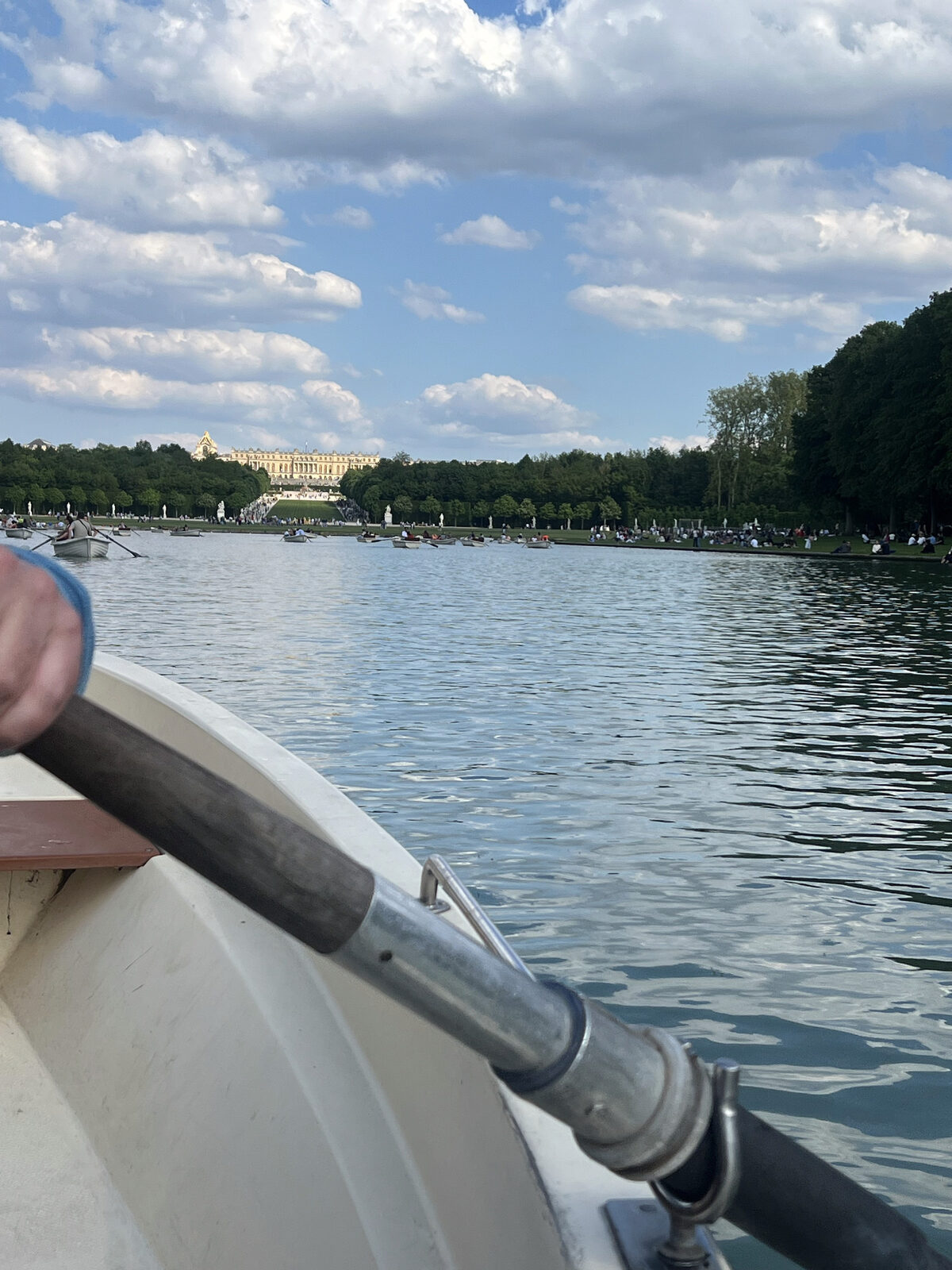
- Rowboats on the Grand Canal — the standout family activity, and it works for everyone, toddlers included (there's room for a stroller at the boat dock). About €16 per half-hour / €20 an hour per boat; rentals are at Petite Venise by the canal, seasonal (closed roughly mid-Nov–Feb). For a lot of kids this is the best hour of the whole day.
- Family bike rental — at Petite Venise by the canal, from about €8 per 30 min (e-bikes and tandems more); the easy way to cover the long distances out to the Trianon and the Hamlet.
- The little green road train — about €9 hop-on, hop-off; it loops the grounds between the palace, the Trianon estate and the Grand Canal. Good for all ages, it saves small (and tired grown-up) legs, and it's the easy way out to the Petit Trianon.
- Golf-cart rental — pricier, but a fun way to roam once the walking is done.
- Snacks & ice cream — there are plenty of kiosks and ice-cream stands through the gardens, so a treat (or a bribe) is never far away.
Marie Antoinette's house & the farm
Out past the main gardens is the Petit Trianon — Marie Antoinette's house — and the storybook Queen's Hamlet, a make-believe village with a real working farm and animals. It's worth it for all ages: the Petit Trianon feels far less crowded than the main palace and is easy to get in and out of, and the Hamlet is a hit with kids and especially teen girls. The one catch: it's a long walk from the main palace entrance — hop the green road train that loops the property, or take bikes or a cart, rather than marching tired kids across the estate.
Four ways to shape the day (pick one template)
Four ways to shape the day
Pick the template that matches your crew, and resist bolting extras onto it.
- A · Minimum Versailles (~4 hrs). Train in, façade and courtyard photos, an optional very short palace highlight (5+ only, with an early timed entry), a gardens stroll and a snack, back to Paris. Treat it as a "taste," not the full thing. Best for 5–10, or toddlers if you skip going inside.
- B · Palace + Gardens classic (~5 hrs). Early train, timed palace entry at opening for 1.5–2 hours, coffee break on exit, then the main garden axis, a few fountains, and an optional boat or golf cart. Best for 7–13.
- C · Gardens + Trianon + Hamlet (5–7 hrs). Outside-first: less time in the crowded palace, more movement, nature and storybook settings. Distances are long, so use the little tram, golf carts or bikes. Best for outdoorsy or imaginative kids 4–12.
- D · Full day (6–8 hrs). Palace (max 2 hours) in the morning, gardens, a canal-side or in-town lunch, then Trianon + Hamlet or extended park time with bikes. Build in real breaks. Best for preteens, teens and high-energy families.
A sample half-day, hour by hour (under-10s)
A sample half-day, hour by hour
A relaxed, gardens-leaning shape for younger kids — slide it to match your timed palace slot:
- ~8:30 · Train out. RER C from central Paris (~30–40 min) plus the short walk; aim to arrive near opening.
- ~9:30 · Palace, fast. Your timed entry — the don't-miss rooms in about 60 minutes, Hall of Mirrors saved for last.
- ~10:45 · Snack & reset. Straight out into the gardens for a sit-down break — water and something small — before anything else.
- ~11:15 · Boat, then roll. A rowboat on the Grand Canal — then cover the property the easy way: the green train or a family bike ride out to the Petit or Grand Trianon. You can do the boat and the train; pick the train or the bike to get around.
- ~12:30 · Picnic on the canal lawns. Bakery supplies from Paris or a kiosk, and let the kids run.
- ~1:30 · Petit Trianon, or home. If everyone's still happy, the (less-crowded) Petit Trianon; if not, drift back to the station while it's still fun.
Want a longer day? Keep adding slow things — more canal, more train, more lawn — not more palace.
Getting there from Paris
Getting there from Paris
The simplest option for families is RER C to Versailles Château–Rive Gauche — about 30–40 minutes from central Paris, then an 8–10 minute walk to the palace. (Two SNCF stations, Rive Droite and Chantiers, also serve the town but leave a longer ~17–18 minute walk.) Aim to be at the palace near opening: shorter queues, cooler temperatures, calmer rooms. Strollers are fine in transit and around town, but expect curbs, gravel and cobbles — and that even a "small" visit is several kilometres on your feet. For the train logistics generally, our getting-around guide covers tickets and the with-kids realities.
Tickets, without the confusion
Tickets, without the confusion
Buy your tickets in advance. Timed palace slots sell out — especially in summer and on weekends — and booking ahead also skips a queue. Buy from the official site (chateauversailles.fr) and pick the simplest ticket that matches your plan. (Confirm current prices and rules there before you go.)
- Timed palace entry is mandatory for everyone — including children who get in free. You book a slot and go straight to the entrance.
- Under-18s (and under-26 EU residents) are free for the palace and Trianon — but they still need a free timed ticket. The single most common mistake is assuming kids need no ticket at all.
- A Passport covers palace + Trianon (+ gardens on fountain-show days); there are also palace-only and Trianon-only tickets. Don't over-buy a full-estate Passport for a family that will realistically only manage the palace and nearby gardens.
- Rough 2026 prices: palace ticket around €21; the full-estate Passport €25 (low season) / €35 (high season, with the fountain shows). Under-18s (and under-26 EU residents) are free — but still need a free timed ticket. (Confirm on chateauversailles.fr — prices shift.)
- On Musical Fountains / Gardens show days (spring–summer weekends), the gardens become ticketed — free only for ages 0–5. Book those in advance too.
- Children's tours and game booklets via the official app are great from about 7+; skip the physical audio-guide queues with little ones.
Prices and show dates on this page were checked in June 2026 — always confirm on the official site before booking.
Food, bathrooms and recovery
Food, bathrooms and recovery
Don't rely on one big lunch. Pack snacks and water and plan an early snack right after the palace, before the midday café crush. Eat near the Grand Canal (kiosks and a restaurant), in town around Place d'Armes, or — best with kids — picnic on the lawns by the canal. There's an Angelina outpost by the palace if you want the treat version. Bathrooms are spread across the palace, gardens, park and Trianon; check the official map and go before you set off between zones. Build in decompression stops: a shaded lawn or canal bank for little ones, a café terrace for teens.
What usually goes wrong (and the rescue)
What usually goes wrong (and the rescue)
| The problem | Prevent it | Rescue move |
|---|---|---|
| Long lines | Timed entry, early slot, official tickets | Pivot to gardens-only; promise space and ice cream |
| Crowds in the palace | Visit at opening, or go outdoors-first | Move fast, skip congested rooms, exit to the gardens |
| Too much walking | One or two focus zones; use tram/golf cart/bikes | Stop at the nearest café or lawn; drop Trianon/Hamlet |
| Palace boredom | Highlights only, keep moving, game booklets | Turn it into a hunt ("find the biggest bed / chandelier") or leave early |
| Heat or rain | Check the forecast; be ready to downgrade | Drop to Minimum Versailles, more café time, head back early |
The reset games still work here
The reset games still work here
Versailles is big, hot and crowd-heavy — classic transition-meltdown territory in the security line and on the long walks. Keep the three reset games close: silly shakes before the security wait, the walk-like game down the garden axis ("march like the king to the canal"), and the five-senses pause in the Hall of Mirrors ("how many of you can you count in the mirrors?").
Season by season
Season by season
Spring is the easiest — mild, blooming, fountains on. Summer brings the shows but also heat and crowds, so go early with hats, water and shade breaks. On Saturday evenings (6 June–19 September 2026) the Grandes Eaux Nocturnes light the gardens and end in fireworks around 11pm — a genuinely magical finale for families who can manage the late bedtime (it's a separate ticket; book ahead). The 14 July (Bastille Day) show is a highlight. Autumn is cooler and quieter; later in the season lean on the architecture and history over bare gardens. Winter keeps the palace impressive but the gardens are stark and cold — do a shorter palace visit and a brief walk. In a heatwave, downgrade to Minimum Versailles without guilt: the walking turns strenuous fast for small kids.
Keep exploring
Pair it with the 3-day itinerary to slot Versailles in without wrecking the week, the getting-around guide for the train, and the introduction to easy days in Paris with kids.
Want Versailles decided for you?
Which zone, which template for your kids' ages, the right train and timed slot, where to eat, and a backup for the day it goes sideways — mapped around your family. That's what we do. Start with our free sample: download The Sailboat & Left Bank Day and follow one Paris morning start to finish.
See the free Sample Edit